
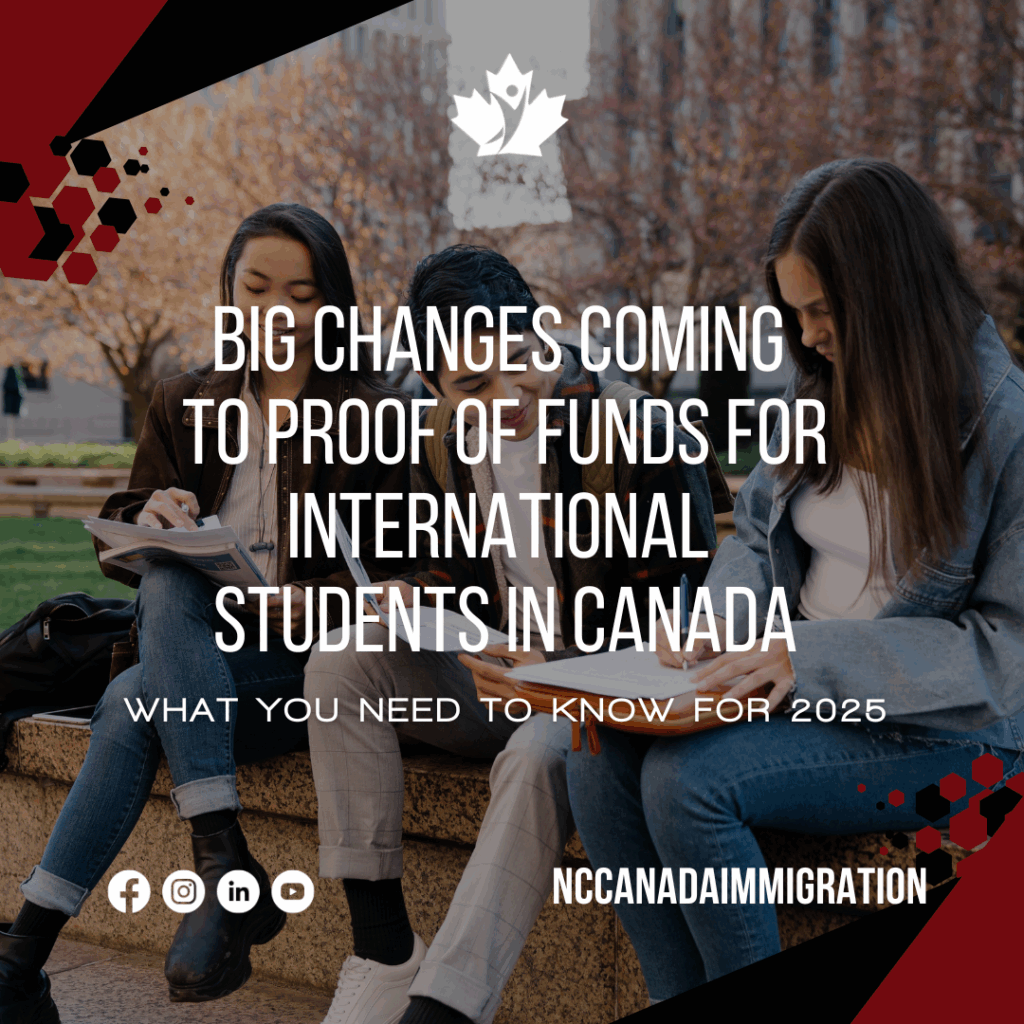
If you are planning to study in Canada, a major update to the proof of funds requirements is about to impact your study permit application. Starting September 1, 2025, the amount of money you must show to cover your living expenses in Canada will increase. This change is part of the government’s effort to ensure international students are financially prepared for life in Canada.
Let’s take a look at everything you need to know about the updated proof of funds, how it compares to the old rules, and how to avoid refusal.
Why Proof of Funds Is Important
The Immigration, Refugees and Citizenship Canada (IRCC) requires all study permit applicants to demonstrate that they can support themselves and any accompanying family members without needing to work in Canada.
Insufficient proof of funds is one of the most common reasons for study permit refusals. The government wants to ensure students can pay for tuition, living expenses, and return transportation, helping protect students from financial stress or exploitation.
IRCC has previously announced an annual increase in requirements for financial resources for study permits. The first increase then took place in January 2024 and will now increase again on September 1, 2025, to keep pace with Canada’s cost of living.
New Proof of Funds Requirements Effective September 1, 2025
The required amounts will go up by about 11% compared to the current figures. Below are the updated minimum living expense requirements (not including tuition or travel) for provinces and territories outside Quebec:
| Number of family members (including the applicant) | Amount of funds required per year (not including tuition) |
|---|---|
| 1 | CAN$22,895 |
| 2 | CAN$28,502 |
| 3 | CAN$35,040 |
| 4 | CAN$42,543 |
| 5 | CAN$48,252 |
| 6 | CAN$54,420 |
| 7 | CAN$60,589 |
| If more than 7 people, each additional family member | CAN$6,170 |
Example: If you are a single student applying after September 1, 2025, you must show that you have at least $22,895 for living expenses, in addition to your first year of tuition and travel costs. A student with two accompanying family members will need $35,040.
If you plan to study in Quebec, note that the province sets its own financial thresholds, which will also be updated separately.
Current Proof of Financial Resources Requirement
| Number of family members (including the applicant) | Amount of funds required per year (not including tuition) |
|---|---|
| 1 | CAN$20,635 |
| 2 | CAN$25,690 |
| 3 | CAN$31,583 |
| 4 | CAN$38,346 |
| 5 | CAN$43,492 |
| 6 | CAN$49,051 |
| 7 | CAN$54,611 |
| If more than 7 people, each additional family member | CAN$5,559 |
Minimum funds for Quebec
| Persons coming to Canada | Amount of funds required (in addition to tuition) |
|---|---|
| You (the student) | $15,508 |
| First family member (18 years or older) | $22,745 |
| Two adults and one family member under the age of 18 | $25,479 |
| Two adults and two family members under the age of 18 | $27,499 |
These figures are updated periodically, so always check Quebec’s official immigration website or the IRCC site for the latest amounts.
Acceptable Documents to Prove Financial Support
You must provide at least one of the following documents:
- Proof that you paid your first year’s tuition and housing fees
- Bank statements with your available funds
- A Guaranteed Investment Certificate (GIC) from a Canadian financial institution
- Proof of a Canadian bank account in your name
- A bank draft convertible to Canadian dollars
- A student or education loan from a bank
- A letter from a person or institution providing you with funds
- Proof of funding from a scholarship or Canadian-funded educational program
All documents should be clear, up to date, and, if not in English or French, accompanied by a certified translation.
Why Canada Is Raising the Bar
This increase aims to reflect the Low-Income Cut-Off (LICO) published by Statistics Canada. Prior to the increase in January 2024, the previous threshold of $10,000, which had been unchanged for over 20 years, did not keep pace with rising housing, food, and transportation costs.
Here’s why this matters for students:
- You will have a realistic budget for living in Canada
- You can avoid running out of funds or taking on extra debt
- You can focus more on your studies and well-being
Additional Tips for Success
- Plan ahead and start gathering financial documents early
- Research the cost of living in the city where you’ll study
- Keep records of any sponsorships or scholarships
Ready to Apply?
Navigating Canada’s study permit requirements can feel overwhelming, especially with these new financial thresholds. If you want personalized guidance to strengthen your application and ensure it aligns with the latest IRCC standards, our experienced team is here to help.
Book a consultation today and get step-by-step support for your study permit application.
The Team at Northern Connections Canada