
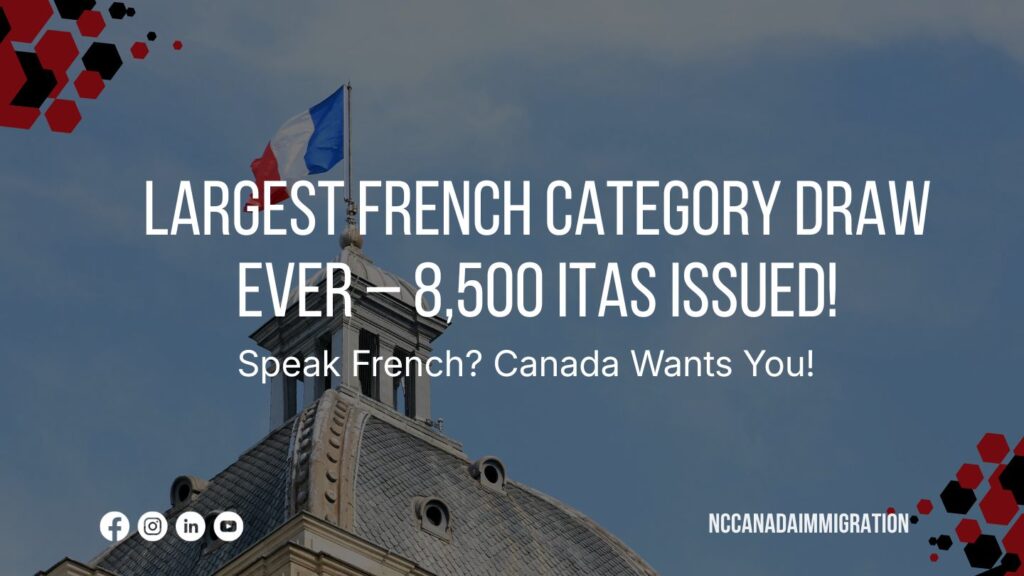
In a historic update for 2026, Canada has made headlines by issuing 8,500 Invitations to Apply (ITAs) in the latest Express Entry draw exclusively for French-language proficiency candidates. This marks the largest-ever draw of its kind, underscoring Canada’s ongoing commitment to welcoming French-speaking newcomers and strengthening Francophone communities across the country.
If you speak French and hope to immigrate to Canada, this recent Express Entry round was a massive opportunity—a clear sign that strong French language skills are in high demand. With more spaces than ever before, those who have prioritized learning French are seeing real advantages in the Canadian immigration process.
In this post, we’ll explore what this record-breaking draw means for aspiring immigrants, highlight key statistics around Francophone targets, and explain how French proficiency can open new doors for your Canadian journey.
A Major Boost for Francophone Immigration
Immigration, Refugees and Citizenship Canada (IRCC) confirmed that 5,000 new selection spaces are now reserved for French-speaking immigrants. This is not just a temporary measure but a strategic part of Canada’s broader Immigration Levels Plan for 2026.
The government recognizes that while Quebec remains the heart of French culture in North America, Francophone minority communities in other provinces need support to thrive. By increasing the intake of French-speaking permanent residents, Canada aims to reverse the decline of the French language in provinces like Ontario, New Brunswick, and Manitoba.
This announcement is particularly exciting because these 5,000 spots are in addition to existing general streams. This means French proficiency is now a more valuable asset than ever before in the Canadian immigration landscape.
Why This Matters for Applicants
For many applicants, the standard Express Entry draws have become incredibly competitive. The Comprehensive Ranking System (CRS) scores required to receive an Invitation to Apply (ITA) often reach high thresholds.
However, category-based selection draws for French speakers often have lower CRS score requirements compared to general draws. These 5,000 additional spots will likely be distributed through these specific mechanisms, making it easier for qualified French speakers to secure their permanent residency.
The Numbers Behind the Strategy
To understand the significance of this news, we need to look at the data. Canada has set ambitious goals to increase the proportion of Francophone newcomers settling outside Quebec. The government is not just talking about support; they are backing it up with hard numbers.
Here is a breakdown of the targets and recent trends surrounding Francophone immigration:
| Metric | Statistic / Target |
| New Francophone PR Spots | 5,000 additional spaces |
| 2025 Francophone Target | 8.5% of total admissions (Achieved 8.9%) |
| 2026 Target | 9% of total PR admissions |
| 2027 Target | 9.5% of total PR admissions |
| 2028 Target | 10% of total PR admissions |
| Key Provinces Targeting Francophones | Ontario, New Brunswick, Manitoba, Nova Scotia |
These statistics reveal a clear upward trend. The government met and exceeded its 2025 goal, which gives credibility to the targets set for 2026 and beyond. If you have French language skills, you are part of a demographic that Canada is actively recruiting.
How to Qualify for Francophone Permanent Residency
You might be wondering, “Do I qualify?” While specific program requirements can vary, the core requirement is proficiency in the French language.
Language Testing
To access these spots, you must prove your language ability. You will need to take an approved language test, such as the TEF Canada (Test d’évaluation de français) or TCF Canada (Test de connaissance du français).
Generally, you need a minimum score of NCLC 7 (Niveaux de compétence linguistique canadiens) in all four categories: reading, writing, listening, and speaking. Higher scores can boost your points significantly in the Express Entry pool.
Immigration Pathways
These 5,000 spots will primarily be filled through two main channels:
- Express Entry: This remains the most popular route. Candidates with strong French skills receive additional CRS points. Furthermore, specific “French-language proficiency” draws invite candidates solely based on their language test results, often bypassing higher CRS requirements found in general draws.
- Provincial Nominee Programs (PNPs): Many provinces have specific streams for French speakers. For example, the Ontario Immigrant Nominee Program (OINP) has a French-Speaking Skilled Worker stream that aligns with Express Entry.
The Benefit for Communities Outside Quebec
This policy isn’t just about filling labor shortages; it’s about cultural vitality. Francophone minority communities across Canada face demographic challenges. An aging population and youth migration can threaten the sustainability of French institutions like schools, community centers, and local media.
By injecting 5,000 new permanent residents into these areas, the government hopes to:
- Fill labor gaps in bilingual sectors like education, healthcare, and customer service.
- Increase enrollment in French-language schools.
- Boost the economic vitality of Francophone towns and neighborhoods.
For an immigrant, this means moving to a community that actually wants you there. Many of these communities offer robust settlement services specifically designed to welcome French speakers, helping you find housing, schools for your children, and employment more quickly.
Start Your Journey Today
The announcement of 5,000 new Francophone permanent resident spots is a clear signal: Canada wants you. If you speak French, do not let this opportunity pass you by. The targets for 2026 are ambitious, and the processing systems are gearing up to welcome newcomers who can contribute to the country’s bilingual success.
Navigating the immigration system can be complex, even with these new opportunities. Ensuring your language test results are valid, your profile is optimized, and you are applying to the right stream is crucial for success.
Ready to find out if you are eligible for one of these 5,000 new spots? Take the first step toward your new life in Canada. Take our free assessment and let our experts guide you through the Francophone immigration process.